
Self-hypnosis, meditation, yoga nidra, NSDR: what sets them apart and where Solva fits in
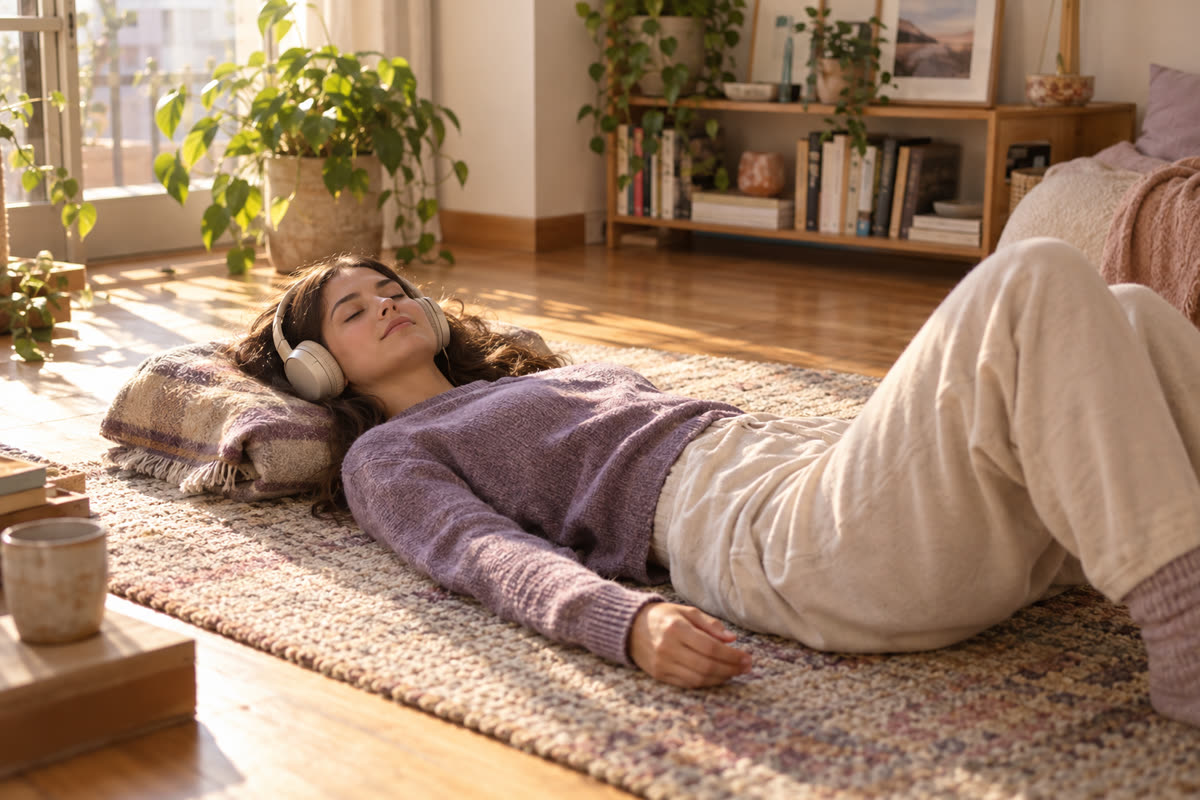
In short: Meditation is attention training: you stay with whatever is present in the moment, again and again. Self-hypnosis deliberately focuses your attention and works with mental imagery and a small number of chosen phrases. Yoga nidra is a guided practice with a fixed structure that you do lying down. NSDR (non-sleep deep rest) is a neutral catch-all label that covers yoga nidra and, taken broadly, hypnosis and certain kinds of meditation as well.
The boundaries between them are soft, and one and the same recording might be described with any of these labels. In this guide we untangle the terminology, walk you through a five-minute exercise so you can sense the difference yourself, and explain where Solva belongs in the picture. Since the Solva team wrote this, keep in mind that we are one of the players in this field.
The four side by side
| Meditation | Self-hypnosis | Yoga nidra | NSDR | |
|---|---|---|---|---|
| Core idea | train attention, notice without judging | a self-induced, focused trance | deep relaxation while staying aware | deep rest without falling asleep |
| Usual position | often sitting | sitting or lying | lying down | lying down or comfortably seated |
| What guides you | a technique, sometimes a voice | your own words and images, or a recording | a teacher's voice, in fixed stages | a guided recording |
| Where attention goes | breath, sounds, the present moment | inward, into a scene and a phrase | body, breath, intention | body sensations and breathing |
| Language | varies by tradition | everyday words | yogic terms | deliberately plain |
Meditation
Rather than a single technique, meditation is a broad family of practices. The US National Center for Complementary and Integrative Health characterizes certain forms as sustained focus on one sensation, like the breath, a sound, an image or a repeated phrase, and it describes mindfulness as holding attention on the present moment without judging it.
Ran D. Anbar, a pediatrician writing in Psychology Today, defines meditation as the use of a technique to train attention and awareness, and notes that it is largely about being in the moment. In the simple breath-focused form, nothing takes you anywhere and no story unfolds, although some forms use images or a mantra. Your thoughts drift off, you register that, and you return.
Self-hypnosis
Jillian Williams, quoted in a Cleveland Clinic article, calls self-hypnosis "a self-induced, intentional trance." Her comparison: the same everyday trance you enter when a book or a movie absorbs you completely. Anbar, for his part, portrays hypnosis as a state of focused attention where a person can become more responsive to suggestion.
Four stages make up a hypnosis session, according to the Cleveland Clinic: the induction, in which you settle and focus; the deepening, frequently built on imagery such as descending a staircase; the suggestions; and the emergence, the step where you return. With self-hypnosis, you guide yourself, using a phrase you picked, or you let a recording guide you. What sets it apart from meditation is that it usually aims at something, even when that something is as modest as "the evening can be quiet now."
Yoga nidra
Another name for yoga nidra is yogic sleep. The Cleveland Clinic explains that you practice it lying down, aiming for profound relaxation while you remain aware. The yoga therapist quoted in the article calls it guided, like some forms of meditation, but very structured.
Sessions tend to follow fixed stages, such as setting an intention, scanning through the body and turning awareness toward the breath. The same source recommends beginning with 15 or 20 minutes. Since the vocabulary is rooted in the yoga tradition, a session sounds quite different from a hypnosis recording, even where the individual steps resemble each other.
NSDR (non-sleep deep rest)
Andrew Huberman, a neuroscientist at Stanford School of Medicine, coined the term NSDR. According to the Sleep Foundation, he introduced it first as a Westerner-friendly label for yoga nidra, then broadened it into an umbrella covering several forms of deep relaxation, hypnosis and some meditation styles included.
On the Huberman Lab page, NSDR practices are described as guided audio that walks you through breathing and body sensation exercises while you lie down or sit comfortably, eyes closed, barely moving. Huberman has published his own recordings in 10, 20 and 30 minute lengths. The page also names "sleep hypnosis" and "body scan" as descriptions of NSDR practices, which underlines just how blurred these borders are.
Pages about NSDR frequently advertise measurable effects. We are skipping those claims here on purpose: this guide covers what the practices are, not what they supposedly do to your body.
What they share, and what separates them
Every one of the four invites you to slow down, direct your attention inward and, most of the time, close your eyes. Nearly all of them work with a recording, and nearly all of them work lying down. The gaps between them are narrower than the labels imply, yet they exist:
- How attention is used. Meditation watches, self-hypnosis directs attention toward an image and a phrase, and yoga nidra and NSDR lead attention through the body along a fixed route.
- The vocabulary. Yoga nidra draws on yogic terms and an intention; NSDR recordings such as Huberman's often use plainer language; self-hypnosis relies on ordinary language and suggestion.
- How it ends. Daytime hypnosis closes with an emergence. Meditation often simply stops. Recordings of every type, when meant for nighttime, often just fade away.
Listening safely
None of these practices belong behind the wheel, on a bike or anywhere else your attention is needed. Once a daytime session ends, allow yourself a few minutes before standing up or driving. Skip these exercises, or speak with a doctor first, if you have had seizures, a dissociative condition or psychosis, if you are going through a very difficult period of your life, or if you doubt whether deep relaxation is right for you. Do not practise under the influence of alcohol or other substances, never in the bath or in water, and stop at any point if something does not feel right.
Try it yourself: three short rounds in five minutes
Find a spot where you can sit or lie down and close your eyes safely. Give each round roughly a minute and a half, then check which of them came most naturally. No outcome is the wrong one.
- Meditation round. Let your breath flow as it does and count every exhale, from one up to ten. If the count slips away, begin again at one, without any commentary.
- Body round (like yoga nidra or NSDR). Take your attention to your right thumb, then through each finger, the palm, the wrist, the forearm, the elbow. Repeat on the left side. Just notice; do not alter anything.
- Self-hypnosis round. Imagine ten soft steps that lead down into a quiet room. On each step, say "calmer" silently to yourself. Once at the bottom, pick one sentence to carry through the rest of your day, for instance "I have enough time for what matters."
- Come back. Count up from one to five, wiggle your hands and feet, breathe in a little more deeply and open your eyes.
When the counting struck you as tedious but the staircase drew you right in, hypnosis-style audio is probably a good match. When the imagery felt artificial but the breathing felt right, meditation is the better starting point.
Where Solva fits
Solva creates hypnosis-inspired audio sessions for wellness. You either describe in one sentence how you are doing or select a moment like Unwind, Recharge or Fall asleep, pick 5, 15, 30 or 45 minutes, and an AI composes a session built from elements of hypnosis and trance: arriving, deepening through imagery, a handful of calm suggestions. Every text is automatically screened against safety rules and then spoken by an AI voice; getting a session ready typically takes 5 to 7 minutes.
Sessions made for the daytime close with a gentle return. Sessions made for falling asleep fade out softly instead, leaving you free to drift off.
What Solva is not
- Not hypnotherapy. Solva is a wellness app, not a medical product, and it is no substitute for professional care.
- Not yoga nidra. There is no yogic framework behind it and no intention-setting ritual.
- Not an NSDR protocol. Solva is not affiliated with Huberman Lab and does not reproduce its recordings.
- Not a meditation course. Solva produces individual sessions rather than teaching a technique step by step.
- Two languages only. App and sessions are in English and German. Solva runs as a web app, is free while we test, and has a waitlist.
Further reading
If you want a bedtime take on self-hypnosis, continue with self-hypnosis for sleep. The differences between the sleep-oriented variants are laid out in sleep hypnosis vs. sleep meditation.
The idea of a session written for your particular moment is explained in personalized meditation. You will find a sample session and the waitlist on our home page.
Sources
- NCCIH, Meditation and Mindfulness: What You Need To Know (last updated June 2022), accessed September 30, 2026
- Ran D. Anbar, What's the Difference Between Hypnosis and Meditation?, Psychology Today (November 13, 2021), accessed September 30, 2026
- Cleveland Clinic, What Is Self-Hypnosis and How Do I Do It? (February 17, 2023), accessed September 30, 2026
- Cleveland Clinic, Hypnosis: What It Is, How It Works, Benefits and Risks (last reviewed January 28, 2025), accessed September 30, 2026
- Cleveland Clinic, What Is Yoga Nidra? (September 14, 2020), accessed September 30, 2026
- Huberman Lab, Non-Sleep Deep Rest (NSDR), accessed September 30, 2026
- Sleep Foundation, What Is Non-Sleep Deep Rest (NSDR)? (Jay Vera Summer, updated May 27, 2026), accessed September 30, 2026
Written with AI assistance; edited and approved by Thomas Gnahm.